Hospital digital twin: plan winter before it arrives.
One live twin of your hospital, joined to the systems you already run. It shows every bed, ward, theatre, fridge and scanner now, and forecasts the beds, staff and medicines you will need next week, next holiday and next year. Codset builds it end to end, in your cloud, on your servers or air-gapped.

Get the 90-day pilot plan
Eight pages, free, sent on screen as soon as you press the button.
- Why winter catches hospitals outSix systems, no forecast.
- What the twin watchesBeds, the ED, theatres, the cold chain, critical equipment.
- What it forecastsHoliday occupancy, New Year medicines, next year's beds.
- How it explains and decidesCited answers, what-ifs, decision records.
- Under the hoodThe stack, the connectors, cloud, on-prem or air-gapped, and support.
- The 90 daysConnect, build and backtest, run decisions.
What the twin forecasts, in the demo hospital
Al Noor Medical City, 520 beds, from the Synopton hospital demo. Demo names and figures are illustrative.
- Peak on 2 January: 104% of bedsHoliday occupancy forecast with an 80% interval. With the plan the twin recommended, the peak drops to 93%.
- Four critical medicines short by New YearAlteplase, an IV antibiotic, salbutamol and O-negative blood, against forecast use while suppliers are closed. Order by 12 December.
- 18 more beds next JanuaryBed demand for 2027 by month, with the drivers: more over-75s, the flu season and a new day unit.
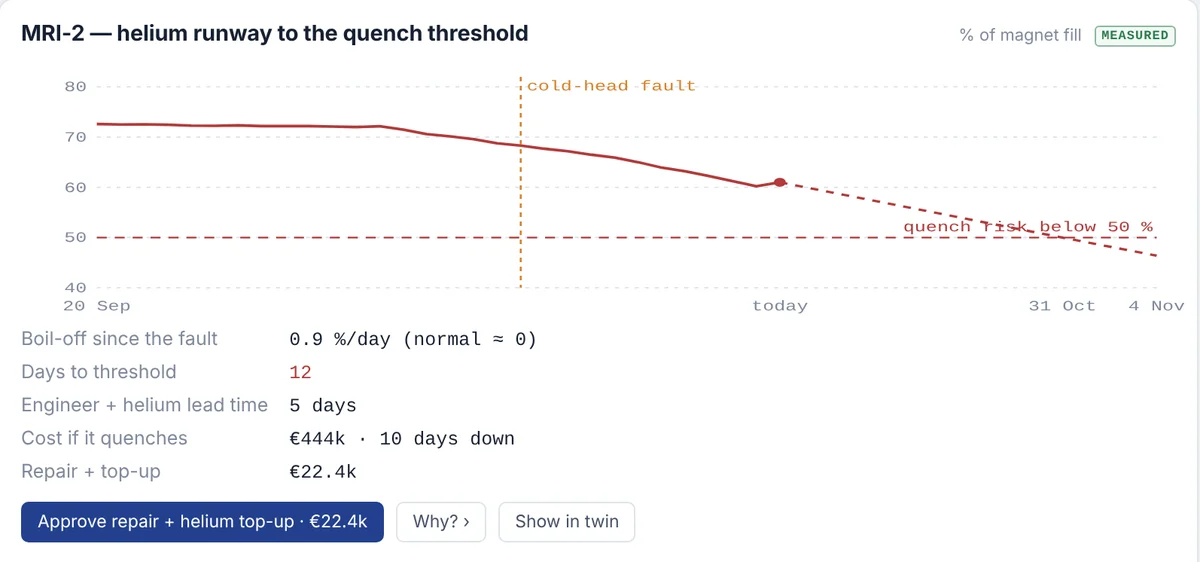
- MRI-2 reaches its helium quench line in 12 daysRepair and top-up €22.4k, against €444k and 10 days down if it quenches.
How it runs in your hospital
Every figure carries its provenance: measured, modelled, published, assumed or forecast.
- ConnectRead-only links to the EHR, PAS and ADT, the lab, pharmacy, the theatre list, the rota, the BMS and the cameras you already have.
- ModelOne patient-flow model and a 3D twin of every ward, theatre, fridge and scanner, built from your drawings.
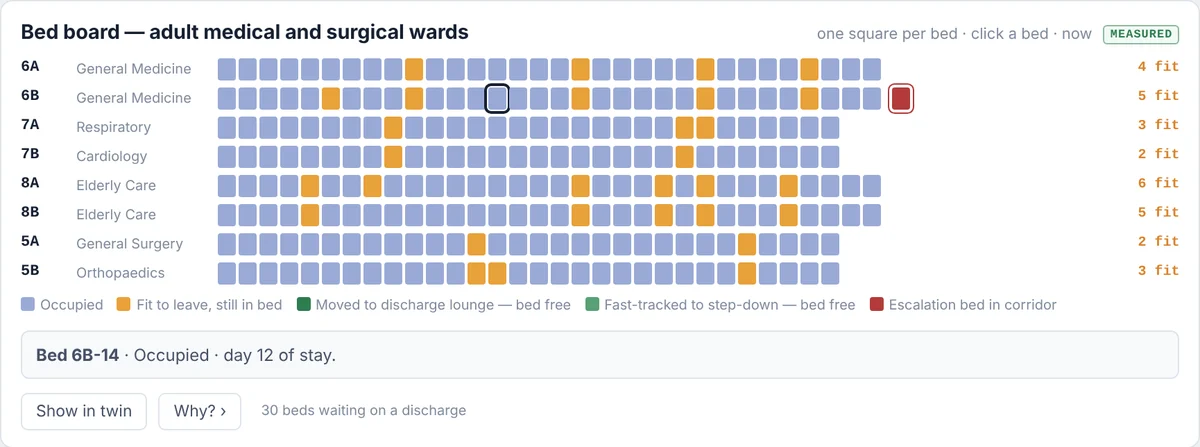
- MonitorBeds, the emergency department, theatres, the cold chain and critical equipment, live, on one screen.
- ForecastOccupancy next week and next holiday, medicines over supplier closures, beds needed next year, equipment runways. Each with its drivers and an interval.
- ExplainAsk why, in plain language. Answers cite the twin's own data: the lab, PAS and ADT, the theatre list.
- DecideTry a plan as a what-if, approve it as a decision record with an owner, and track the measured result.
Under the hood
The stack, the connectors and where it runs.
- Data modelHL7 FHIR, HL7 v2, DICOM and exports mapped to one patient-flow model; every value keeps its unit, time and source.
- ForecastingSeasonal time series and gradient boosting, backtested on past winters, with drivers and 80% intervals.
- AI answersLanguage models grounded in the twin's own data, with citations, on hosted or local models.
- 3D twin and visionThree.js and WebGL in the browser; detection on existing ONVIF camera streams, faces blurred.
- ConnectorsEHR, PAS and ADT, LIS, PACS, pharmacy, theatre list, rota, nurse call, RTLS, BMS, cold-chain sensors, SAP, Microsoft 365, Power BI. Read-only.
- InstallationYour Azure, AWS or Google Cloud tenant, your own servers on Kubernetes or VMs, or fully air-gapped.
- Privacy and securityPseudonymised analytics, SSO over SAML or OIDC, role-based access, an audit log, REST API and webhooks.
- SupportA named delivery lead, optional 24/7 on-call, scheduled updates. The code and IP are yours.
One hospital. 90 days.
- Weeks 1 to 2 · ConnectRead-only access to the systems in scope, drawings for the twin, and one page of the questions it must answer.
- Weeks 3 to 6 · Build and backtestThe twin with every source mapped, and forecasts backtested on your last three winters. Usable from week six.
- Weeks 7 to 12 · Run decisionsBed meetings, pharmacy orders and theatre planning run through it, each recommendation priced and owned.
Questions buyers ask
Does the twin touch patient care or clinical systems?
No. Connectors are read-only. The twin reads from the EHR, PAS and the other systems in scope; accepting a recommendation drafts a decision record for people to agree. Nothing is written back.
How is patient data protected?
Analytics run on pseudonymised data, with single sign-on, role-based access and an audit log of every view and decision. Your information governance lead is part of the pilot from day one, and data residency and retention follow your rules.
Can it run on-premises or air-gapped?
Yes. It runs in your Azure, AWS or Google Cloud tenant, on your own servers, fully air-gapped with offline model updates, or hosted by us.
Which systems can it connect to?
The EHR over HL7 FHIR, PAS and ADT over HL7 v2, the lab, PACS over DICOM, pharmacy, theatre list, rota, nurse call and RTLS; the BMS over BACnet, cameras over ONVIF and cold-chain sensors; SAP, Microsoft 365, Teams and Power BI. Exports work where an interface is not available.
How accurate are the forecasts?
Each forecast is backtested on your own past winters before anyone relies on it, and shows its drivers and an 80% interval. When reality differs, the twin records it and the next forecast learns from it.
Who supports it after the pilot?
A named delivery lead from the team that built it, with optional 24/7 on-call support. Models, connectors and security patches are updated on an agreed schedule, and the code and IP built for you are yours.
How soon is it useful?
The twin is usable from week six of a 90-day pilot. Start by early autumn and your team plans the winter peak with it.